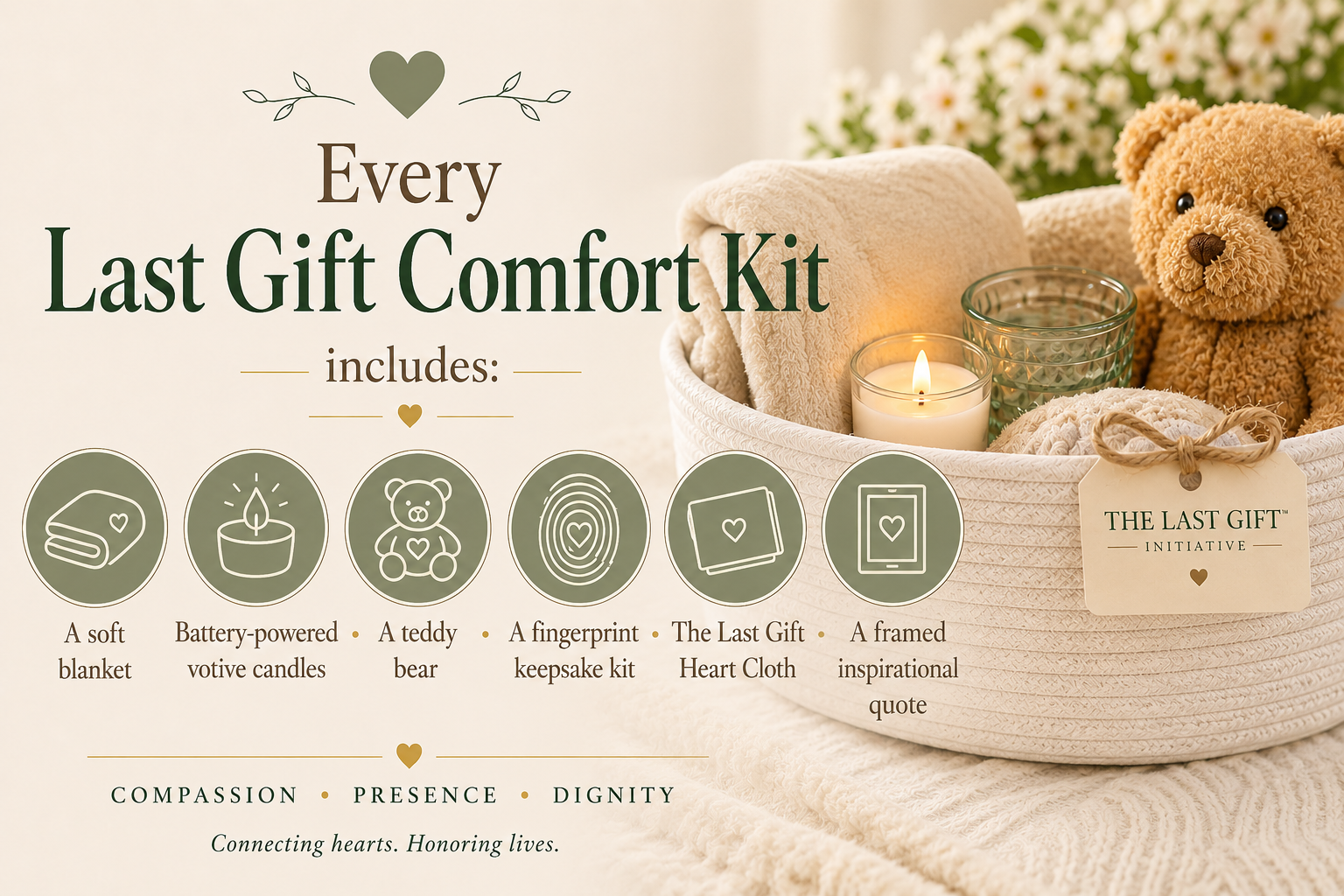
Every item in this basket was chosen with intention. This lesson tells you what each one is, what it means, and exactly how to use it.
"These are not decorations. They are acts of love made visible in a room where love might otherwise have no face."
Before the basket enters the room
Every Last Gift Comfort Kit is prepared before it enters a resident's room. The contents are tailored based on one key question: is there a family member or loved one who will want keepsakes? If the answer is no — if no one will be receiving the fingerprint card or Heart Cloth — those items are removed from the basket before it goes in and returned to inventory for a future kit.
This decision is made at intake. When you arrive for your shift, the basket will already be appropriately prepared — either by the coordinator or according to the intake information on file. If you are ever unsure what should be in the basket, contact your coordinator before proceeding.
Family / keepsakes wanted
Full basket goes in — including Heart Cloth and fingerprint card and ink pad.
Keepsakes are collected and returned to coordinator or given directly to family.
No family / no keepsakes
Heart Cloth and fingerprint card are removed before the basket enters the room.
They are returned to inventory for a future basket. No fingerprinting is done.
What's in the kit — and how to use it
Here is every item in the Last Gift Comfort Kit, what it means, and exactly what you do with it when you arrive in the room.
Battery-operated votive candles
5–6 per basket
Soft candlelight transforms a clinical room into something warmer and more human. The battery-operated votives are safe for facility use — no open flame, no fire risk, no need for staff approval.
They signal something wordlessly: someone was here. Someone cared enough to light a light.
How to use
Turn each one on and place them around the room. Good spots include the food tray table, nightstand, windowsill, and the top of a dresser or TV stand if present. Keep them clear of tubing, oxygen equipment, and linens. If you are unsure where is safe, ask a nurse or aide before placing.
Soft blanket / throw
One per basket
Warmth is one of the most basic human comforts. A soft blanket placed over someone who can no longer ask for it is a profound act of care — even if they cannot feel it consciously, the gesture matters.
The blanket may already be on the bed when you arrive if a previous volunteer placed it. If not, it is yours to offer.
How to use
If the blanket is not already in use, drape it gently over the resident. Do not place it if the person is running a fever or if the room feels warm — comfort, not warmth for its own sake, is the goal. If in doubt, ask the aide. At the end of your shift, if the blanket has bodily fluids on it, dispose of it — do not return it to the basket. If it is clean and the family does not want it, it may be laundered and reused.
Teddy bear
One per basket
The teddy bear serves two purposes depending on who is in the room. For a family member who is struggling — a child, a grieving spouse, anyone who needs something to hold — the bear is for them. For a resident with no family present, the bear is placed near them as a companion presence.
If the resident passes with no family coming, the bear goes with them — to the funeral home or crematory. It does not stay in the basket. It accompanies the person who had no one.
How to use
If family is present, offer the bear gently — you might simply place it within reach without comment. If no family is present, place it near the resident — on the bed beside them or on the nightstand. When the person passes, inform facility staff that the bear should accompany them. Attach a small note if available identifying it as a Last Gift item.
"You Are Not Alone" framed piece
One per basket
This small framed piece carries the heart of everything this program stands for in four words. It belongs as close to the resident's bedside as possible — ideally placed before they are in the final stages of active dying, so that it has time to be seen.
If family is present, it may bring them comfort as much as the resident. It is a visible reminder that this moment has been witnessed and honored.
How to use
Place it on the nightstand or food tray table — as close to eye level and the bedside as the room allows. If the frame is already in place from a previous volunteer or from the intake process, leave it where it is unless there is a reason to move it. This is the first thing to place when you arrive.
The Last Gift Heart Cloth
Included when keepsakes are wanted · Our signature ritual
The Heart Cloth is ours. It is the ritual that belongs to this program and no other. A small, soft cloth — folded and tied with a bow when it arrives in the basket — placed flat over the area of the heart in the final hours of life.
The intention behind it is simple and profound: this cloth rests closest to the last beating heart. It is there when the heart's final rhythms pass through it. It is, in a sense, a recording of those last moments — something a family can hold that was held against the one they loved as they left.
Many cultures and faith traditions have practices around the heart and its significance at death. We honor those traditions by asking about them at intake. If a family's beliefs would make this practice uncomfortable or inappropriate, we do not use it — and we note this before the basket enters the room.
How to use
If consent was obtained at intake: Untie the bow gently. Unfold the cloth fully. Place it flat on the skin directly over the heart. It may remain there for minutes or hours — there is no set time. When the person passes, carefully fold it and place it back in the basket.
If consent was not obtained or is unclear: Place the Heart Cloth gently over the clothing at the chest — not on the skin. This is the respectful default when you are uncertain.
If there is no family to receive it: The Heart Cloth does not need to be used. It will have been removed from the basket before you arrived.
Fingerprint kit
Included when keepsakes are wanted · Ink pad + 4×6 card
A fingerprint is one of the most intimate keepsakes a family can receive — something uniquely, irreplaceably that person. The kit contains a fresh ink pad and a 4×6 card with a clearly marked area for the print. The goal is one or two clear thumbprints, or a thumb and index finger — whichever seems most manageable given the circumstances.
The best time to take a fingerprint is before active dying is complete — while the hand is still pliable. Do not wait until after death if you can help it, as the process becomes more difficult. Ideally, fingerprinting is done at intake when the family meets with the coordinator. If it was not done then, and a family member wants it, it falls to you.
If you feel uncomfortable or uncertain, you may ask a facility aide to assist you. You do not have to do this alone.
Step by step
1
Place the 4×6 card on a hard, flat surface — a clipboard, book, or food tray table works well. This is essential for a clear print.
2
Open the ink pad. Press the resident's thumb or finger gently but firmly onto the pad to coat it evenly.
3
Press the inked finger firmly onto the marked area of the card. Roll slightly side to side to capture the full print. Lift straight up.
4
Repeat with a second finger if possible — a thumb and index finger is ideal. Two prints gives the family a choice.
5
Fill in the name and date on the card. Place it back in the window box it came in, and return the box to the basket.
6
At the end of your shift, bring the basket — including the card — to your coordinator, or follow the end-of-shift protocol for your situation.
The basket tag and identification
Every basket carries a tag that reads: "This Last Gift Basket was given in loving memory of: [Name]." If the basket was donated by someone in memory of a loved one, a donor card will also be attached noting who donated it — along with The Last Gift Initiative logo and website.
A second note on the basket or attached tag reads: "Please leave this basket for the family of [Name]." This is for facility staff — so that if the basket is found in the room without a volunteer present, staff know to preserve it for the family rather than removing it.
What happens to the basket at the end of your shift
Family is present / involved
Leave the basket in the room, clearly labeled. Family manages their own keepsakes. Staff can provide the basket to family or it is picked up with belongings.
Your job is presence — not logistics. The basket takes care of itself.
No family present
Collect keepsakes (fingerprint card, Heart Cloth). Place them back in the basket. Take the basket with you and call Trisha or Vonnie — they will arrange pickup or make other arrangements.
If you cannot take the basket, leave it bedside and note this when you debrief.
If the family is not local and will not be coming to collect the basket, keepsakes — the fingerprint card and Heart Cloth — may be mailed to them for a shipping fee. Your coordinator will handle this. You do not need to arrange it yourself.
Your laminated checklist
Every basket includes a laminated instruction sheet covering each item — what it is, how to use it, and what to do with it at the end of your shift. You will receive this at intake along with your field guide. Keep it in the basket so it is always there when you need it. If anything in this lesson feels unclear when you are in the room, that sheet is your reference.
"You don't need to remember every step perfectly. You need to be present, move with intention, and know that the laminated sheet is there if you need it."
Every candle you light, every blanket you place, every print you take with careful hands — these are not tasks. They are the last tangible acts of love a stranger will ever offer this person. Do them slowly. Do them with care. They matter more than you may ever know.
Lesson 5 — Knowledge Check
The Last Gift Comfort Kit
Answer all six questions, then submit to complete Lesson 5. Your results will be sent to your training coordinator.
Question 1 of 6
Before the basket enters the room, the Heart Cloth and fingerprint card are removed if:
Question 2 of 6
Where should the "You Are Not Alone" framed piece be placed?
Question 3 of 6
You should place the soft blanket on the resident even if they are running a fever.
Question 4 of 6
If consent for the Heart Cloth was not obtained at intake, you should:
Question 5 of 6
When taking a fingerprint, why is a hard surface behind the card important?
Question 6 of 6
If the resident passes with no family coming, what happens to the teddy bear?
Please answer all questions and enter your name before submitting.